|
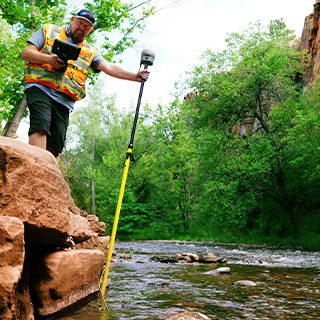
 | Calm Water, Moving Rock
Trimble Technology Helps Scientists Gain New Insights From Old Data |
|
 | City of Napa Hydrographic Survey
When California’s City of Napa needed a hydrographic survey near a proposed boat dock on the Napa River, they knew who to call: James Dickey, PLS, president of Cinquini and Passarino, Inc., had completed previous hydrographic surveys. |
|
 | Signs of Change in Belgium
Question: How many road signs are there in the Dutch-speaking region of Belgium? Answer: We don’t know for sure yet but we will soon. Not only that, but we’ll know how many of each type, size and color, exactly where they are—and their condition. |
|
 | A Royal Project
Today’s 3D scanning is a great tool for historical preservation, but it’s not always accessible for projects (difficult implementation, limited budgets, technology unknown by archaeologists, etc). Instead, archaeologists may still use traditional theodolites (at best), or (at least) only paper, tape measure and crude charcoal copying methods. Used in this project to help prepare an historic palace in southwest Germany for restoration, the Trimble VX Spatial Station offers a powerful alternative to 3D scanning: surveying techniques
are already known by archaeologists and the new technology provides both 3D scanning and imaging data. |
|
 | Big Step for a Small Country
Trimble Technology Helps a Developing Country Move Forward |
|
 | Image Integration: A High-Productivity Approach to Managing Digital Photography for Surveyors
Surveyors today employ a variety of ways for documenting their field surveys. Measurements and descriptions are recorded in electronic data collectors. Audio recorders can be used to record comments and parol evidence from property owners and other stakeholders. Field books contain sketches and detailed notes. And survey crews frequently use digital photographs to provide visual documentation of monuments and work sites. |
|
 | In the Wake of a Hurricane
When Mark W. Huber watched the record storm surges of Hurricane Katrina breach New Orleans’ 17th
Street Canal, he had one thought: “Life’s not going to be the same now.” Huber is with the U.S. Army Corps of Engineers, and in August 2005 he was responsible for the QA/QC of the Corps' survey operations in Louisiana, which put him in charge of ensuring the quality of the post-Katrina surveys in the region. That
same evening, Jimmy Chustz, PLS, was having similar thoughts: “It was devastating to watch it all happen,” he says. |
|
 | Drilling Holes in the Desert
Precision is a requirement that is drilled into and
expected from field crews at Boart Longyear, a leading drilling services provider. So when the company was first awarded a critical, multi-milliondollar upgrade project, it prepared itself with the essential technology and expertise it needed to perform the work. |
|
 | Giving a Boost to Energy Development
Stretching across north Texas, the Barnett Shale
formation is one of the largest onshore deposits
of natural gas in the U.S. Much of the gas lies beneath
the developed Dallas/Fort Worth region, and crews face
many challenges getting the gas out of the ground and
to the market. The new pipelines and facilities require
easements, rights-of-way and construction. |
|
 | State-of-the-Art Surveying for State-of-the-Art Museum
After more than 50 years, New York City’s Museum of Arts and Design (MAD) had outgrown its original location. The New York City Economic Development Corporation (NYCEDC) recommended a vacant building at 2 Columbus Circle for the museum's new home. Ideal in size and layout, the new site would also boast one of the city’s most renowned addresses. However, it also posed an enormous and unique technical challenge, which Langan Engineering met by innovatively employing Trimble technology. |